Greenhouse Ventilation
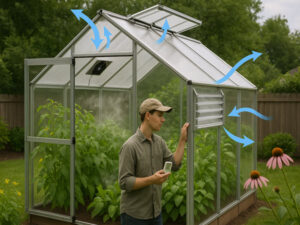
Greenhouse Ventilation: How to Improve Airflow, Temperature, and Humidity
Greenhouse ventilation is essential for maintaining healthy growing conditions. Without adequate air exchange, a greenhouse can quickly become too hot, excessively humid, or poorly supplied with fresh air.
A well-designed greenhouse ventilation system helps remove excess heat, manage humidity, replenish carbon dioxide, and create more consistent growing conditions.
There are two main approaches: natural ventilation using roof and side vents, and mechanical ventilation using powered fans and controlled air inlets. Many greenhouses benefit from a combination of both.
This guide explains how greenhouse ventilation works, how to choose the right equipment, and how to manage airflow throughout the year.
Natural vs. Mechanical Greenhouse Ventilation
| Ventilation Type | How It Works | Best Suited For | Advantages | Limitations |
|---|---|---|---|---|
| Natural Ventilation | Uses wind and temperature differences to move air through vents. | Small to large greenhouses with suitable vent design and outdoor conditions. | Low operating energy use and relatively simple equipment. | Performance varies with wind, temperature, and vent area. |
| Mechanical Ventilation | Uses exhaust fans and air inlets to exchange greenhouse air. | Greenhouses requiring more predictable airflow or automated control. | Controllable airflow and compatibility with thermostats. | Requires electricity, maintenance, and correctly sized equipment. |
| Hybrid Ventilation | Combines natural vents with powered fans. | Greenhouses with changing seasonal ventilation requirements. | Flexible operation and potential energy savings. | Requires coordination between vents, fans, and controls. |
Why Is Greenhouse Ventilation Important?
1. Prevents Excessive Heat
Sunlight passing through greenhouse glazing can rapidly increase indoor temperatures.
Without sufficient ventilation or cooling, greenhouse temperatures may rise above the range suitable for the plants being grown.
High temperatures can interfere with flowering, fruit development, and overall plant growth.
Ventilation replaces warm greenhouse air with outdoor air when outdoor conditions allow useful cooling.
2. Helps Control Humidity
Plants release water vapor through transpiration, while wet soil and other surfaces contribute additional moisture.
Excessive humidity can encourage condensation and create conditions favorable to certain plant diseases.
Ventilation can help remove moisture when the incoming air has suitable drying potential.
However, ventilation is not always an effective dehumidification method when outdoor air is already very humid.
3. Replenishes Carbon Dioxide
Plants use carbon dioxide during photosynthesis.
In a tightly closed greenhouse, carbon dioxide concentrations can decline during periods of active photosynthesis.
Fresh-air exchange helps replenish the greenhouse atmosphere.
Commercial growers may also use controlled carbon dioxide enrichment, but this requires appropriate equipment and safety precautions.
4. Reduces Stagnant Air
Air movement helps reduce localized temperature and humidity differences.
Circulation fans can move air around plant canopies and reduce stagnant areas.
However, internal air circulation is different from ventilation: circulation fans move existing air, while ventilation exchanges indoor air with outdoor air.
5. Supports Disease Management
Good airflow can help reduce prolonged leaf wetness and condensation under suitable conditions.
This may lower the risk of certain fungal and bacterial diseases.
Ventilation alone does not eliminate pests or diseases, so sanitation, irrigation practices, and crop monitoring remain important.
Natural Greenhouse Ventilation
Natural ventilation relies on wind and temperature differences rather than powered exhaust fans.
Warm air tends to rise, allowing it to escape through roof openings while replacement air enters through suitable lower vents.
Wind can also create pressure differences that move air through the greenhouse.
Roof Vents
Roof vents provide an escape route for warm air that accumulates near the top of the greenhouse.
They can be particularly effective when combined with appropriately positioned side vents.
Sidewall Vents
Sidewall vents allow outdoor air to enter the greenhouse.
Depending on greenhouse design and wind conditions, they can also function as exhaust openings.
Roll-Up Sides
Some hoop houses and polytunnels use roll-up sidewalls to increase natural airflow.
These openings can provide substantial ventilation during favorable weather.
Automatic Vent Openers
Temperature-responsive vent openers can adjust ventilation without requiring manual operation.
Some use wax-filled cylinders that expand as temperatures rise.
They are useful for small greenhouses, although their opening force, temperature range, and compatibility must match the vent.
Advantages of Natural Ventilation
- Low electricity consumption.
- Relatively simple operation.
- Can provide substantial airflow when vents are properly sized.
- Suitable for many hobby greenhouses.
- May reduce the need for powered cooling during favorable weather.
Limitations of Natural Ventilation
- Airflow varies with wind and outdoor temperature.
- Small or poorly positioned vents may restrict air exchange.
- Cooling is limited when outdoor air is very hot.
- Manual systems require regular attention.
- Insect screening can reduce airflow if vent areas are not adjusted.
Mechanical Greenhouse Ventilation
Mechanical ventilation uses powered equipment to exchange air between the greenhouse and outdoors.
It is often used where more predictable airflow is required or natural ventilation is insufficient.
Exhaust Fans
Exhaust fans remove greenhouse air and draw replacement air through intake openings.
Fan capacity should be selected based on greenhouse dimensions, cooling requirements, and the resistance created by shutters, screens, and other components.
Air Intake Louvers
Intake louvers provide openings through which replacement air enters.
They must be sized appropriately to avoid excessive airflow resistance.
Horizontal Airflow Fans
Horizontal airflow fans circulate air within the greenhouse.
They help distribute heat and moisture more evenly, but they do not replace the need for outdoor air exchange.
Thermostats and Controllers
Temperature controllers can activate exhaust fans or open motorized vents when the greenhouse reaches a selected temperature.
More advanced controllers may also monitor humidity, ventilation stages, and other environmental conditions.
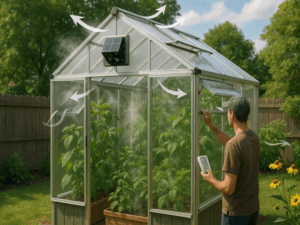
How Much Ventilation Does a Greenhouse Need?
Ventilation requirements depend on greenhouse size, solar exposure, outdoor weather, plant density, shading, and cooling goals.
For mechanical ventilation, airflow capacity is commonly expressed in cubic feet per minute (CFM).
A basic air-exchange calculation is:
Required CFM = Greenhouse Volume (cubic feet) × Desired Air Changes per Hour ÷ 60
This calculation provides a useful starting point, but it does not by itself determine the correct summer cooling capacity.
Actual greenhouse ventilation design should consider solar heat gain, temperature targets, equipment performance, and local conditions.
Example Greenhouse Airflow Calculation
Suppose a greenhouse has an interior volume of 1,200 cubic feet.
If the design calls for 30 air changes per hour:
1,200 × 30 ÷ 60 = 600 CFM
The calculated airflow is 600 cubic feet per minute.
This is an illustration of the formula, not a universal recommendation for a greenhouse of that size.
Summer cooling requirements may call for a different airflow rate.
Why Fan Ratings Matter
Fans may be rated under specific test conditions.
Actual airflow can be lower when shutters, screens, ducts, or other restrictions create static pressure.
Choose fans using performance information appropriate for the intended installation.
How to Choose the Right Greenhouse Ventilation System
Greenhouse Size and Shape
A compact backyard greenhouse may be adequately ventilated with roof and side vents under suitable conditions.
Larger greenhouses may require more extensive vent areas, powered fans, or a hybrid system.
Local Climate
Hot climates may require shading, substantial ventilation, or additional cooling equipment.
Cool climates may require controlled air exchange to manage moisture while limiting unnecessary heat loss.
Plant Requirements
Different crops respond differently to temperature, humidity, and air movement.
Choose environmental targets based on the plants being grown rather than assuming one setting works for every greenhouse.
Automation Requirements
Automatic vent openers, thermostats, and environmental controllers can reduce the need for constant manual adjustments.
Automation is especially useful when greenhouse conditions change rapidly during the day.
Operating Costs
Natural ventilation generally requires less electricity, while powered systems have equipment and operating costs.
However, mechanical systems may provide more consistent control when outdoor conditions permit effective cooling.
How to Improve Greenhouse Air Circulation
Ventilation and circulation should work together.
Even when a greenhouse has sufficient fresh-air exchange, stagnant areas may develop around dense foliage or behind benches.
To improve internal airflow:
- Use appropriately positioned circulation fans.
- Avoid blocking vents with shelving or stored equipment.
- Maintain suitable spacing between plants.
- Prune crops when appropriate to improve canopy airflow.
- Inspect corners and densely planted areas for condensation.
- Avoid directing excessively strong airflow at delicate plants.
The goal is gentle, consistent air movement rather than strong drafts.
Greenhouse Ventilation in Summer
Summer ventilation focuses primarily on preventing excessive heat accumulation.
Open Vents Early
Where conditions allow, begin ventilation before greenhouse temperatures become excessive.
Automatic controls can help prevent delayed vent opening.
Use Shade Cloth When Appropriate
Shade cloth reduces incoming solar radiation and can lower cooling demand.
Choose shading levels based on crop light requirements and local conditions.
Consider Evaporative Cooling
Evaporative cooling systems use water evaporation to reduce air temperature.
They are generally more effective in relatively dry conditions than in very humid climates.
Water quality, maintenance, and humidity effects must be considered.
Monitor Temperature at Plant Level
Temperature readings near the roof may differ from conditions around the crop canopy.
Place sensors where they provide useful information about the plants’ actual growing environment.
Greenhouse Ventilation in Winter
Winter ventilation requires balancing moisture control, air quality, and heating costs.
Keeping a greenhouse tightly closed can reduce heat loss, but excessive humidity and condensation may still develop.
Use ventilation when needed to manage conditions rather than following a fixed schedule regardless of weather.
Use Short Ventilation Cycles When Appropriate
In heated greenhouses, controlled air exchange can help remove moisture while limiting unnecessary heat loss.
Maintain Internal Air Circulation
Circulation fans can help reduce temperature differences and stagnant pockets.
However, internal fans alone do not remove moisture from the greenhouse.
Watch for Condensation
Condensation on glazing, foliage, or structural surfaces can indicate that humidity and surface temperatures need attention.
Avoid Excessive Cold Drafts
Direct exposure to cold incoming air can stress sensitive crops.
Arrange air inlets and circulation equipment to distribute incoming air appropriately.
Greenhouse Ventilation Equipment and Automation
The following product categories may help improve ventilation or environmental control.
Affiliate disclosure: Some product displays on this page may earn us a commission from qualifying purchases at no additional cost to you.
1. Solar-Powered Ventilation Fans
Solar-powered fans may be useful for selected small greenhouses or off-grid installations.
Performance depends on available sunlight, fan capacity, and whether the system includes battery storage.
Check actual airflow ratings and power requirements before purchasing.
2. Automatic Thermal Vent Openers
Thermal vent openers use temperature-responsive mechanisms to operate compatible greenhouse windows or vents.
They can provide convenient ventilation without a powered controller.
Confirm the opening temperature, lifting capacity, and mounting requirements.


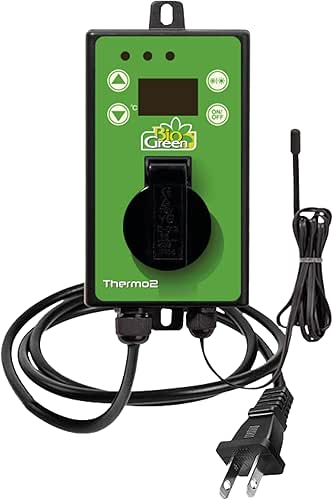
3. Environmental Controllers and Monitoring Equipment
Controllers can automate fans, vents, and other greenhouse equipment based on environmental readings.
Some devices provide simple temperature control, while others offer more advanced monitoring.
Check which sensors, outputs, and control functions are included.
4. Evaporative Cooling Equipment
Evaporative cooling equipment may help reduce incoming air temperature under suitable conditions.
Its effectiveness depends heavily on outdoor humidity, water supply, and system design.
Check whether the selected product is appropriate for greenhouse cooling and compatible with your ventilation setup.

Product note: These four affiliate shortcodes have been preserved from the original article. Current availability, specifications, and suitability have not been independently verified.
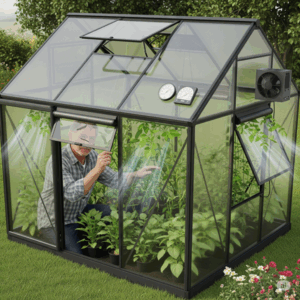
DIY vs. Commercial Greenhouse Ventilation Systems
DIY Greenhouse Ventilation
A basic DIY system may include manual vents, a suitable exhaust fan, intake openings, and a thermostat.
This approach can work for small hobby greenhouses when equipment is selected and installed correctly.
Electrical equipment must be suitable for damp greenhouse environments and installed according to applicable safety requirements.
Commercial Greenhouse Ventilation
Commercial systems may include staged exhaust fans, automated vents, environmental sensors, and integrated cooling controls.
They are designed around the greenhouse’s airflow, heat load, and crop requirements.
Professional design assistance may be appropriate for larger or more complex installations.
Common Greenhouse Ventilation Mistakes
Installing Fans That Are Too Small
Undersized exhaust fans may not remove enough heat during warm weather.
Calculate airflow requirements rather than selecting fans solely by their physical dimensions.
Providing Insufficient Intake Area
Even a powerful exhaust fan can perform poorly if replacement air cannot enter freely.
Intake openings must be appropriately sized and positioned.
Confusing Circulation with Ventilation
Circulation fans redistribute indoor air but do not introduce fresh outdoor air.
Both functions may be needed.
Ignoring Seasonal Changes
Summer and winter ventilation requirements differ.
Adjust settings according to temperature, humidity, and crop conditions.
Failing to Maintain Equipment
Dirty shutters, damaged fan blades, obstructed screens, and stuck vents can reduce system performance.
Inspect equipment regularly.
Assuming Ventilation Always Cools the Greenhouse
Ventilation generally moves indoor conditions toward outdoor conditions.
When outside air is extremely hot, ventilation alone may not maintain suitable crop temperatures.
Shading or other cooling methods may be necessary.
Greenhouse Ventilation Maintenance Checklist
- Inspect roof vents and side vents for smooth operation.
- Clean debris from shutters and intake openings.
- Check fan blades and guards.
- Inspect motors and electrical connections according to manufacturer instructions.
- Clean or replace filters if the equipment uses them.
- Check thermostat and sensor readings.
- Confirm automatic vent openers operate correctly.
- Inspect insect screens for blockage or damage.
- Review settings when seasons change.
- Check for condensation and stagnant air around plants.
Frequently Asked Questions About Greenhouse Ventilation
How often should I clean or replace greenhouse fan filters?
Not all greenhouse ventilation fans have filters.
If your system includes filters, inspect them regularly and clean or replace them according to the manufacturer’s instructions.
Dusty environments or heavily used systems may require more frequent maintenance.
Can I run greenhouse ventilation on a timer instead of sensors?
Yes, timers can operate fans on a fixed schedule.
However, temperature and humidity conditions change throughout the day, so sensor-based controls often provide more responsive operation.
A thermostat is particularly useful for preventing overheating.
Should I keep my greenhouse sealed during winter?
A greenhouse may remain closed for periods when conditions are suitable, but humidity, condensation, and air quality should be monitored.
Controlled ventilation may be needed even during cold weather.
There is no universal requirement to leave vents continuously open.
Do greenhouses need ventilation at night?
Nighttime ventilation depends on temperature, humidity, and crop requirements.
Some greenhouses benefit from controlled air exchange or internal circulation at night.
Others may remain closed when conditions are acceptable.
What is the best way to add carbon dioxide to a greenhouse?
Fresh-air ventilation is the simplest way to replenish carbon dioxide in many hobby greenhouses.
Controlled CO2 enrichment may be useful in some commercial growing systems.
Compressed-gas systems require appropriate controls, monitoring, and safety precautions. Fuel-burning CO2 generators introduce additional combustion and air-quality risks and should not be improvised.
Is natural ventilation enough for a small greenhouse?
It may be sufficient if the greenhouse has appropriately sized vents and favorable outdoor conditions.
However, small greenhouses can overheat rapidly, so monitor temperature and consider automatic vent operation or supplemental fans.
Where should greenhouse exhaust fans be installed?
Fan placement depends on greenhouse dimensions, intake locations, and desired airflow patterns.
Exhaust fans are often positioned to draw air across the growing area from appropriately located inlets.
Follow a suitable ventilation design rather than assuming one location works for every greenhouse.
Can greenhouse ventilation reduce plant diseases?
Ventilation can help manage humidity and leaf wetness, which may reduce conditions favorable to certain diseases.
It does not eliminate disease risk, and good sanitation, irrigation management, and plant spacing remain important.
Do I need both exhaust fans and circulation fans?
Not every greenhouse requires both, but they serve different purposes.
Exhaust fans exchange air with the outdoors, while circulation fans move air within the greenhouse.
Using both may improve environmental uniformity in some installations.
Will solar-powered fans work at night?
A solar fan connected directly to a solar panel generally operates only when sufficient sunlight is available.
Nighttime operation requires an appropriate energy storage system or another power source.
Greenhouse Ventilation FAQ Summary
| Question | Key Consideration | Practical Tip |
|---|---|---|
| How often should filters be replaced? | Depends on equipment and dust accumulation. | Follow manufacturer maintenance instructions. |
| Timer or sensor control? | Sensors respond to changing conditions. | Use a thermostat where overheating is a concern. |
| Keep the greenhouse sealed in winter? | Monitor humidity and condensation. | Ventilate when conditions require it. |
| Ventilate at night? | Depends on nighttime temperature and humidity. | Use controlled ventilation when needed. |
| Add CO2? | Fresh air supplies CO2; enrichment needs controls. | Prioritize safe ventilation and monitoring. |
Recommended Reading
Explore these related greenhouse gardening guides:
- Greenhouse Humidity Control — Learn how to manage moisture and condensation.
- Greenhouse Watering System Parts — Explore the equipment used in greenhouse irrigation.
- Greenhouse Watering System — Compare different greenhouse watering methods.
- Best Victorian Greenhouses for Your Backyard — Discover traditional greenhouse designs and their features.
Final Thoughts on Greenhouse Ventilation
Effective greenhouse ventilation helps control temperature, manage humidity, replenish carbon dioxide, and improve growing conditions.
Natural vents, mechanical exhaust fans, and hybrid systems can all work well when matched to greenhouse size, climate, and crop requirements.
For small backyard greenhouses, properly positioned vents and automatic openers may provide a practical starting point. Larger or more demanding installations may benefit from powered ventilation and environmental controls.
Monitor conditions at plant level, maintain equipment regularly, and adjust ventilation as the seasons change.
For more greenhouse gardening information, visit Greenhouse Guide.